
When the iPhone first launched, I wasn’t immediately sold. Multitouch was elegant, yes – but elegance isn’t enough. It took until the iPhone 3GS for Apple to combine interaction innovation with real-world utility: performance, 3G, and a feature set that justified abandoning my tactile, button-driven Nokia E Series. That’s when software-first interaction stopped being a demo and became a product.
The problem is what happened next.
Entire industries cargo-culted multitouch. They copied the interface paradigm without interrogating the context. Screens became default, not deliberate. Interaction models were transplanted without asking whether they improved the job to be done.
The automotive industry is one of the clearest examples. When the Mk8 Golf R replaced physical controls with capacitive touch sliders and haptic panels, usability regressed overnight. Core driving interactions – climate, volume, driver assists – moved from muscle memory to menu navigation. The friction wasn’t theoretical; it was immediate. I didn’t buy the car because of it. And VW has been iterating back toward physical controls ever since.
When I saw what incredible work Jony Ive / Marc Newson had done recently with their LoveFrom partnership with Ferrari in the ‘Luce’ I had to put this piece together. There are tons of learning from their approach.
It all started when the car industry looked at the iPhone and learned exactly the wrong thing.
They saw a billion-unit product with a touchscreen and thought: we should put touchscreens everywhere or touch ‘surfaces’ everywhere. So they ripped out physical controls that had worked for a century and replaced them with glass surfaces that force you to look away from the road.
In this wonderfully detailed video from Ferrari, Jony Ive and Marc Newson’s LoveFrom work with the car manufactuer is laid out as a wonderful example of how many years later the man who inadvertently ruined car interiors is now trying to fix them with the Ferrari Luce.
Jony Ive put it bluntly: “To use touch in a car is something I would never dream of doing, because it requires that you look at what you’re doing.”
What he’s building offers a masterclass in what the industry should have learned in the first place – lessons that matter for anyone building products where hardware and software meet.
What They Should Have Copied
The iPhone’s touchscreen wasn’t a feature – it was the solution to a specific problem: how do you build one device that’s a camera, typewriter, calculator, and web browser? You need a general-purpose interface. The touchscreen was the answer.
Your car doesn’t have that problem. Temperature adjustment, volume control, heated seats – these aren’t general-purpose tasks. They had excellent solutions: knobs, buttons, switches. The industry “unresolved” problems that were already solved.
Here’s what actually mattered about the iPhone:
Start with six months of research.
Before drawing a single line, LoveFrom produced four substantial books for Ferrari – philosophy, design history, cultural context. These weren’t mood boards. They were arguments about first principles. The car industry sketches first, researches later. Do the research right, and the design becomes self-evident.
One team, not silos.
LoveFrom’s industrial designers and UI designers worked as one unit. They designed hardware and software simultaneously. Press a physical button and the display responds in real time. That coherence exists because the same people designed both sides at the same time. Every car company has separate teams for exterior, interior, software. The result is exactly what you’d expect.
Design each component as a complete product.
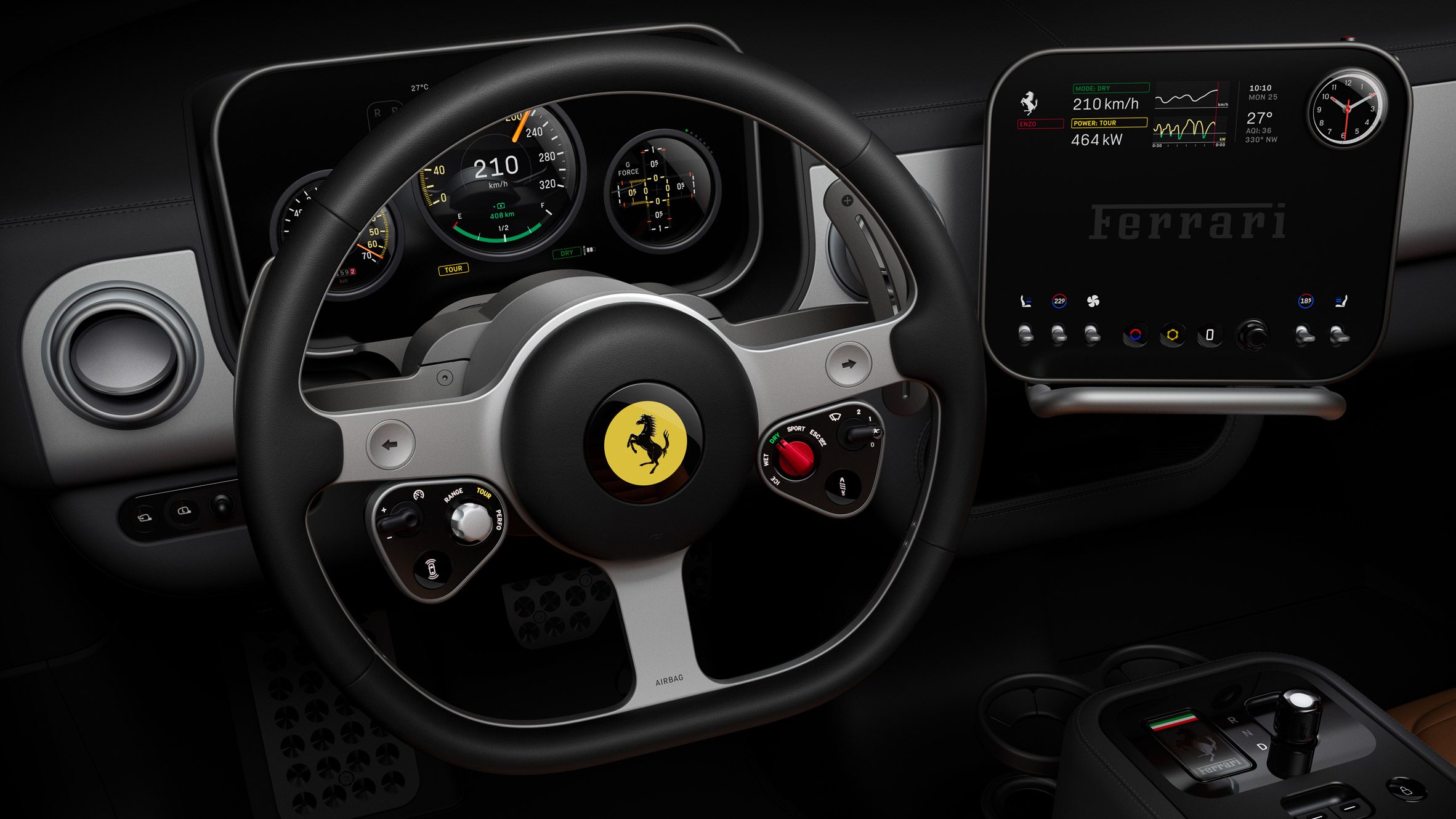
Traditional car parts are odd shapes filling leftover space. LoveFrom designed every piece such as the steering wheel, binnacle, control panel, shifter, key, as if it were a standalone product, then integrated them. Marc Newson called it “a project of a thousand products.” You could put any component on a museum plinth and it would hold up.
Physical controls for critical functions.
The central control panel has a handle that serves as a palm rest—a physical datum point. Every button on the steering wheel feels different so you can identify them by touch. Formula One drivers and fighter pilots figured this out decades ago: controls you reach for in critical moments get dedicated physical hardware.
The Deeper Principles
Function is beauty. Ive said it plainly: “If you can’t use something, it’s ugly.” A gorgeous interface that forces users to look away from what matters isn’t beautiful – it’s ugly. The ugliness is the dysfunction. The beauty is the solution.
Build it finished. Ferrari isn’t playing the continuous-update game. Their head of development: “We are not used as Ferrari to have update software many times during their lifetime. That’s the masterpiece – it’s done.” Connectivity ages out. Cloud dependencies break. Third-party services shut down. Precision engineering and truthful materials last.
Theatre is infrastructure. The Ferrari’s E Ink key is yellow in your pocket, fades to black when you dock it, while the binnacle lights up in sequence. The white glass shifter turns yellow “now touch this part.” This isn’t decoration. It’s communication. The sequence tells users what state the system is in and what to do next without requiring a manual.
Materials communicate. The interior is aluminium, glass, and leather. Nothing pretends to be something it’s not. Corning needed seven new process innovations to meet the specs. Users judge internal quality by external materials. If you want them to trust what your product does, start with truthful materials.
The Loneliness of Being Right
Listen to the audio of Ive’s Q&A and you can hear him struggling: “What would be lovely would be for the thinking to be talked about, not the shapes.”
He’ll make this car whether anyone learns from it or not. That’s the job. But you can hear him pleading for someone to look past the aluminium and glass and see why.
Sometimes it is just very hard to convey empirical thinking, taste, good design – a quandary I’ve often struggled with. It is also why some people are great at design and other not – often tastemakers see this as binary.
To try and explain ‘good’ design you can start with why. This means deeply researching your domain and then bringing one team a long for the entire journey. Each item or component you build be it physical or software should be a complete product. They should hold up on their own. That could be a selection toggle in an app, or a switch in a car. Useful truthful interactions, designs or materials so your items feel finished all on their own.
The shapes might be Ferrari but it is the thinking works everywhere hardware and software meet.
Action Card
Protect attention, not aesthetics
THIS WEEK: Choose one constrained flow (motion, stress, split focus).
Don’t “modernise” it with more screens.
INSTEAD: Design the eyes-free path. Critical actions must be instant, repeatable, and usable without looking — via placement, shortcuts… or hardware.
If the UI steals attention, it’s the wrong interface.
“Touch is a power tool. Use it where the user has attention to spare. For everything else, design an interface they can use without thinking — or looking.”